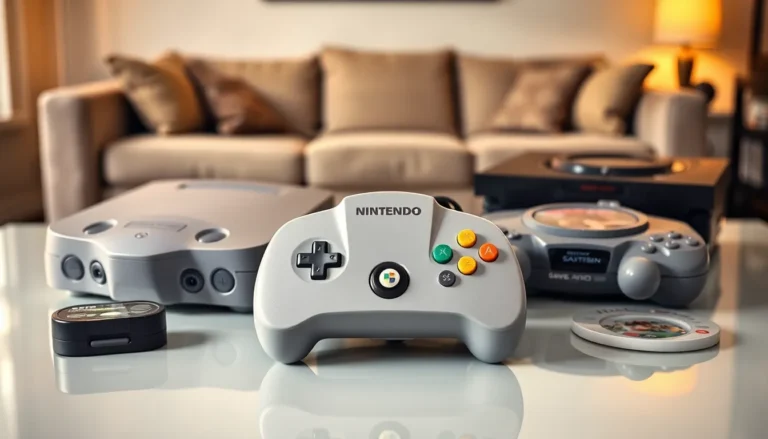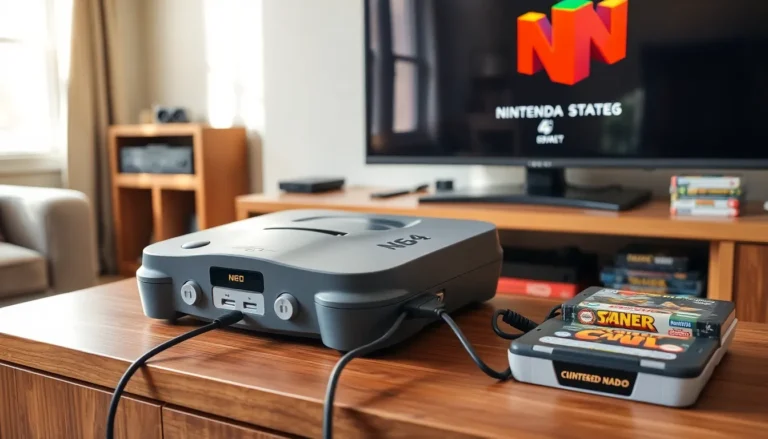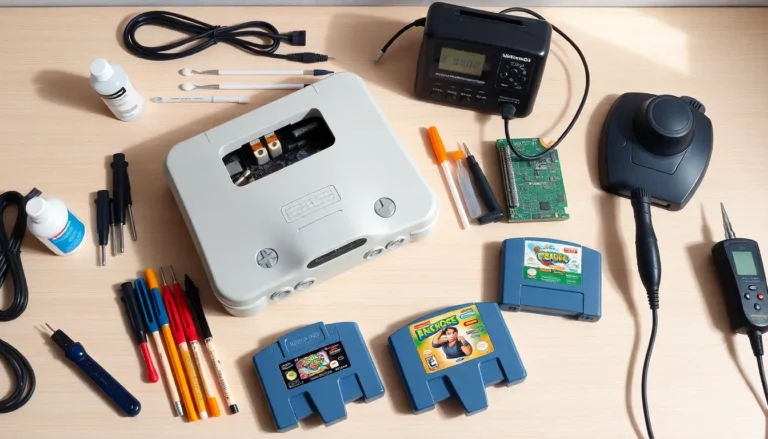

Nintendo 64 examples showcase some of the most influential games and hardware innovations in gaming history. Released in 1996, the N64 introduced millions of players to true 3D gaming. The console sold over 32 million units worldwide and produced titles that still influence game design today. From groundbreaking platformers to revolutionary multiplayer experiences, Nintendo 64 examples represent a pivotal moment when gaming grew up. This article explores the landmark games, technical achievements, and lasting impact that made the N64 a defining console of its era.
Table of Contents
ToggleKey Takeaways
- Nintendo 64 examples include landmark titles like Super Mario 64, GoldenEye 007, and Ocarina of Time that revolutionized 3D gaming and multiplayer experiences.
- The N64’s analog stick controller and four built-in controller ports set new standards for how players interact with games.
- Accessories like the Expansion Pak, Rumble Pak, and Transfer Pak extended the console’s capabilities and introduced features now standard in modern gaming.
- GoldenEye 007 and Mario Kart 64 proved that local multiplayer could drive console sales and create lasting social gaming experiences.
- Camera systems and movement controls pioneered in Nintendo 64 examples remain foundational in today’s third-person action and platforming games.
- The collectathon genre and design philosophies from N64 games continue to inspire modern indie developers and spiritual successors.
Landmark Games That Shaped the Console’s Legacy
The Nintendo 64 library contains some of the most celebrated titles in gaming. These games pushed boundaries and established formulas that developers still use today.
Revolutionary 3D Platformers
Super Mario 64 stands as the definitive Nintendo 64 example of 3D platforming done right. Launching alongside the console in 1996, it introduced players to free-roaming 3D environments with precise analog control. The game’s hub world, Princess Peach’s Castle, became a template for open-world design. Players could explore at their own pace, collecting Power Stars across 15 distinct worlds.
Banjo-Kazooie, developed by Rare, expanded on Mario’s foundation. It added item collection, character abilities, and humor that appealed to older audiences. The bear-and-bird duo demonstrated how Nintendo 64 examples could iterate on established formulas while adding fresh mechanics.
Donkey Kong 64 pushed the collect-a-thon genre further. With five playable characters and hundreds of items to find, it showed the N64’s capacity for large-scale adventures. These platformers proved that 3D gaming could deliver experiences impossible on previous hardware.
Groundbreaking Multiplayer Experiences
GoldenEye 007 changed everything for console shooters. Released in 1997, it brought first-person multiplayer action to living rooms worldwide. Four players could battle across iconic movie locations using an arsenal of weapons. The game sold over 8 million copies and proved mature titles could thrive on Nintendo platforms.
Mario Kart 64 perfected the racing party game formula. Its four-player split-screen mode made it essential for social gatherings. Tracks like Rainbow Road and Koopa Beach became instant classics. This Nintendo 64 example set the standard for kart racers that persists today.
Super Smash Bros. created an entirely new fighting game genre. Nintendo characters battled across stages pulled from company history. The four-player chaos proved more accessible than traditional fighters while maintaining competitive depth. It spawned a franchise that now dominates the competitive gaming scene.
Perfect Dark built on GoldenEye’s success with advanced AI bots and more complex multiplayer options. These Nintendo 64 examples demonstrated that local multiplayer could drive console sales and create lasting social experiences.
Technical Innovations and Hardware Features
The Nintendo 64 introduced hardware features that changed how people played games. Its controller alone represented a major shift in design philosophy.
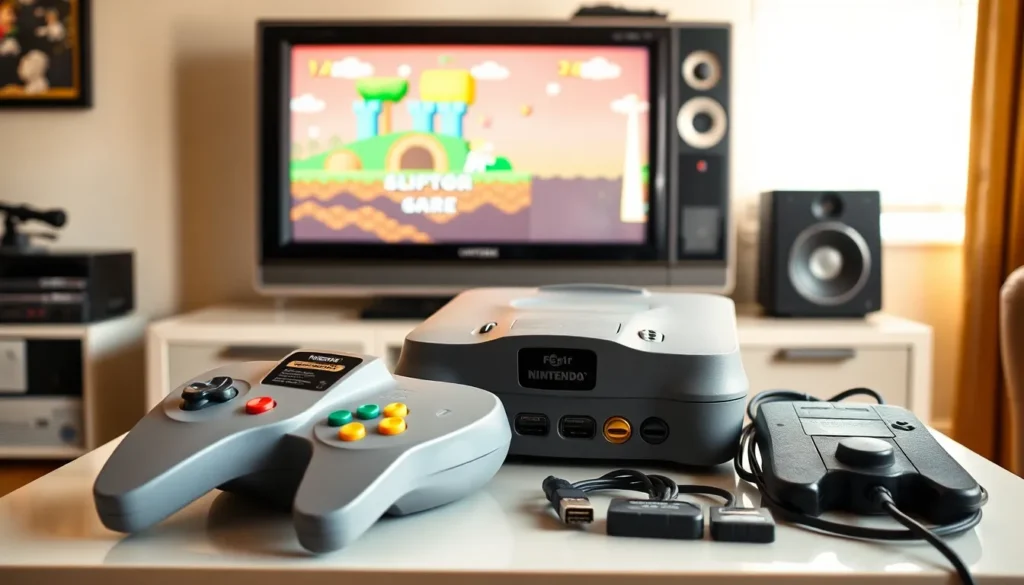
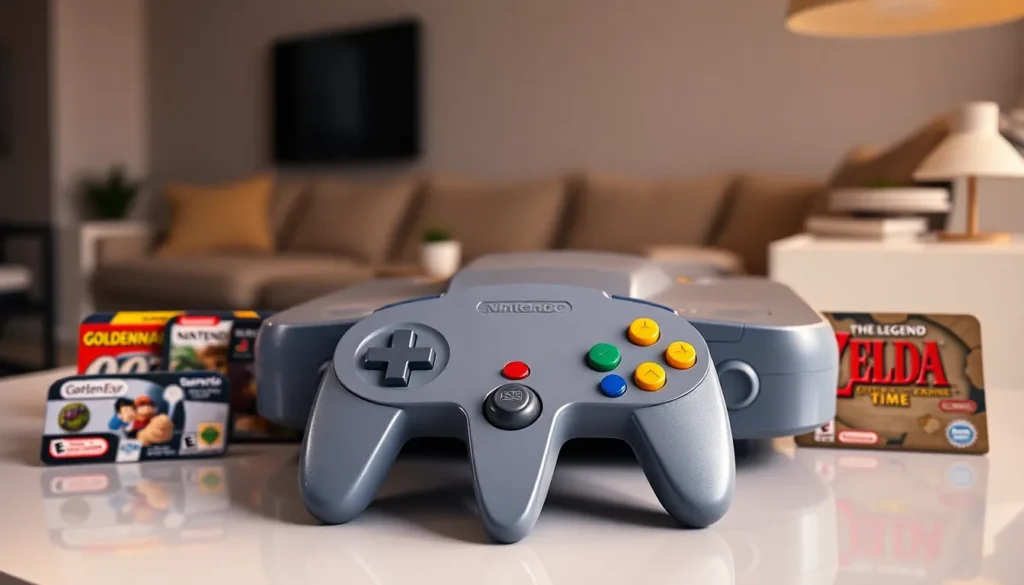
The N64 controller featured an analog stick as its primary input method. This stick allowed 360-degree movement with variable pressure sensitivity. Players could walk slowly or run at full speed based on stick position. The design influenced every major controller that followed.
Four controller ports came standard on every console. Previous systems required adapters for multiplayer beyond two players. Nintendo 64 examples of multiplayer games flourished because the hardware supported them out of the box.
The console used cartridges instead of CDs. This choice had tradeoffs, cartridges cost more and held less data, but they loaded games instantly. No load screens interrupted gameplay in most titles. The decision shaped how developers designed Nintendo 64 games.
The system’s graphics processor handled texture mapping and anti-aliasing that gave games a distinctive smooth look. While competitors offered higher resolution, the N64 delivered consistent frame rates in demanding 3D environments. Games like The Legend of Zelda: Ocarina of Time demonstrated what the hardware could achieve with skilled optimization.
Notable Accessories and Expansion Packs
Nintendo 64 examples of innovative accessories expanded what the console could do. These add-ons addressed hardware limitations and enabled new gameplay possibilities.
The Expansion Pak doubled the console’s RAM from 4MB to 8MB. Some games required it, Donkey Kong 64 wouldn’t boot without one. Others used it for enhanced graphics or resolution. Perfect Dark and Majora’s Mask showed significant improvements with the accessory installed.
The Rumble Pak introduced force feedback to console gaming. Bundled with Star Fox 64, it let players feel explosions and impacts through the controller. This Nintendo 64 example became standard in future controllers from all manufacturers.
The Controller Pak provided memory card storage for game saves. While many games saved directly to cartridges, sports titles and others used the Pak for additional data. Players could carry their progress between consoles.
The Transfer Pak connected Game Boy cartridges to N64 games. Pokemon Stadium let players battle their trained teams on the big screen. This accessory bridged handheld and console gaming in ways that predicted modern cross-platform play.
Lasting Influence on Modern Gaming
Nintendo 64 examples continue to shape game design decades later. The console’s innovations appear throughout modern gaming.
Camera control systems pioneered on N64 remain industry standard. Ocarina of Time’s Z-targeting let players lock onto enemies and circle them during combat. Nearly every third-person action game uses some version of this system today.
Analog stick movement became universal after the N64 proved its value. Modern controllers feature two analog sticks, building on what Nintendo introduced. The precision required for 3D platforming demanded this evolution.
Local multiplayer gaming reached its peak on the N64. While online play eventually replaced couch co-op for many genres, the social gaming model persists in party games and fighting titles. Nintendo 64 examples like Mario Party established templates still used in modern releases.
Rare’s partnership with Nintendo produced Nintendo 64 examples that influenced entire genres. GoldenEye shaped console shooters. Banjo-Kazooie inspired indie platformers. Perfect Dark’s AI systems predicted features that took years to appear elsewhere.
The collectathon genre born on N64 has seen revival through titles like A Hat in Time and Yooka-Laylee. Developers who grew up with Nintendo 64 games now create spiritual successors that honor those influences.