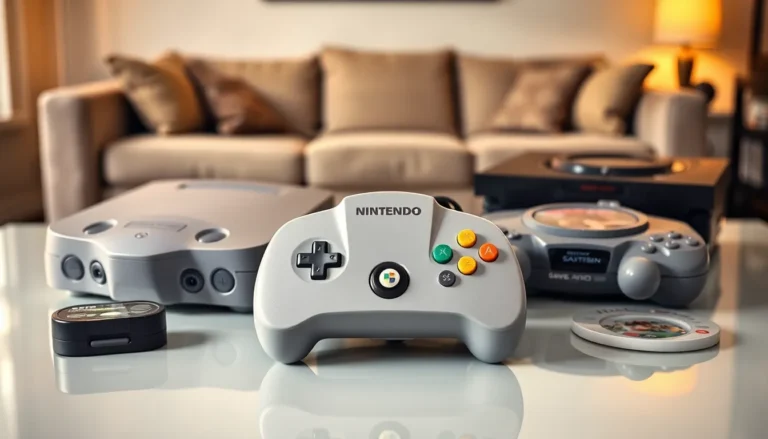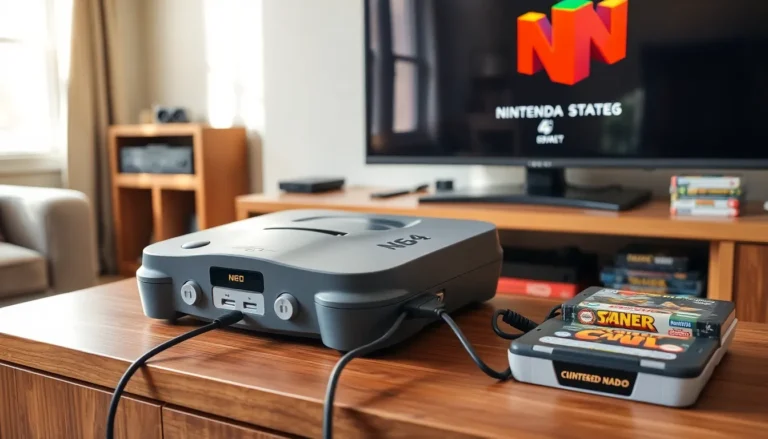

What is Nintendo 64? It’s the home console that changed how people played video games in the mid-1990s. Nintendo released this 64-bit system in 1996, and it quickly became a household name. The Nintendo 64 introduced millions of players to 3D gaming with titles that still influence game design today. This guide covers the console’s history, technical specs, best games, and lasting impact on the gaming industry.
Table of Contents
ToggleKey Takeaways
- Nintendo 64 is a 64-bit home console released by Nintendo in 1996 that revolutionized 3D gaming.
- The console sold approximately 32.93 million units worldwide and featured iconic games like Super Mario 64 and The Legend of Zelda: Ocarina of Time.
- Nintendo 64 introduced the analog stick and Rumble Pak, which became industry standards for all future gaming controllers.
- The four built-in controller ports made the Nintendo 64 the go-to console for local multiplayer gaming experiences.
- Despite using cartridges instead of CDs, the console’s library of 388 games included many titles that still influence game design today.
- Collectors and retro gaming fans can access Nintendo 64 games through the Nintendo Switch Online Expansion Pack.
The History and Launch of the Nintendo 64
Nintendo launched the Nintendo 64 in Japan on June 23, 1996. North America received the console on September 29 of the same year. Europe and Australia followed in March 1997. The system arrived during a critical period in gaming history.
The Nintendo 64 was the successor to the Super Nintendo Entertainment System (SNES). Nintendo faced stiff competition from Sony’s PlayStation and Sega’s Saturn. Both rivals had already entered the market with CD-based systems.
Nintendo made a bold choice. The company stuck with cartridges instead of CDs. This decision had pros and cons. Cartridges loaded games faster and were harder to pirate. But, they cost more to produce and held less data than CDs. Third-party developers often chose to release games on PlayStation instead because of lower production costs.
The Nintendo 64 launched with just two games in North America: Super Mario 64 and Pilotwings 64. Super Mario 64 became an instant hit. It showed players what 3D gaming could look like. The game sold over 11 million copies and set the standard for 3D platformers.
Nintendo priced the Nintendo 64 at $199.99 in the United States. This competitive price helped the console gain early momentum. By the end of its lifespan, the Nintendo 64 sold approximately 32.93 million units worldwide.
Key Features and Technical Specifications
The Nintendo 64 earned its name from its 64-bit central processing unit. This CPU was a custom NEC VR4300 running at 93.75 MHz. At the time, this represented a significant leap in processing power for home consoles.
The system included 4 MB of RAM, which could be expanded to 8 MB with the Expansion Pak accessory. Several games required this upgrade to run at higher resolutions or unlock additional features.
Graphics processing came from the Reality Coprocessor, developed in partnership with Silicon Graphics. This chip handled 3D rendering, audio processing, and other tasks. The Nintendo 64 could display up to 150,000 polygons per second under optimal conditions.
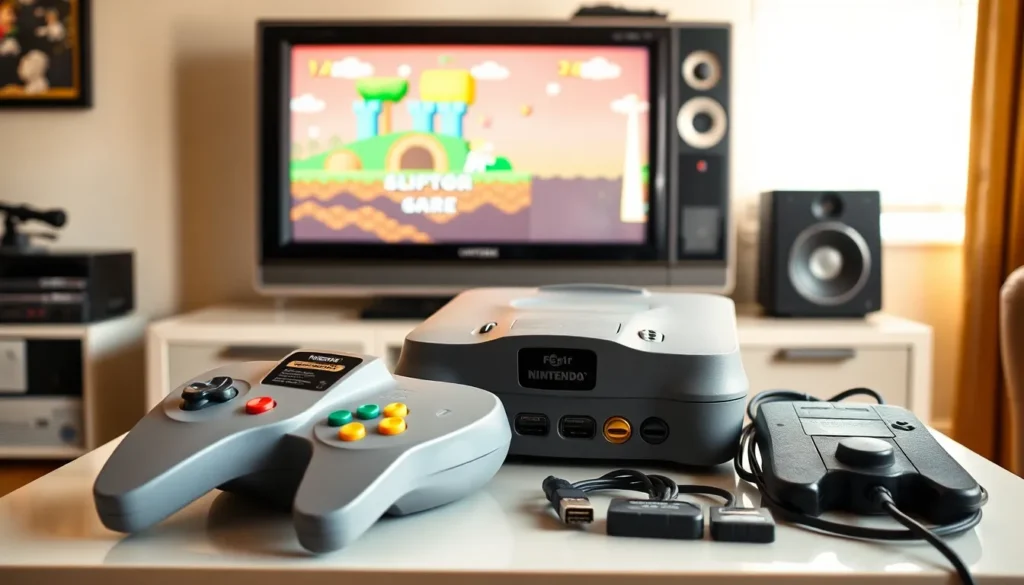
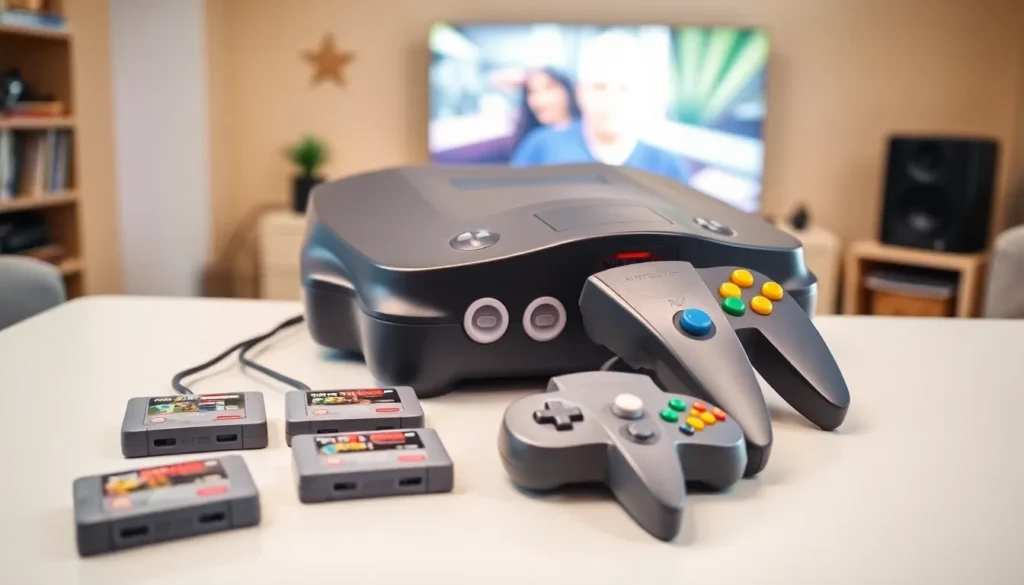
The controller introduced several innovations. It featured an analog stick, a first for mainstream home consoles. This stick allowed precise 360-degree movement, perfect for 3D games. The controller also included a trigger button (Z button) on the back and an expansion port for accessories like the Rumble Pak.
The Rumble Pak debuted with Star Fox 64 in 1997. It added force feedback to gameplay, letting players feel explosions and impacts. This feature became an industry standard.
Key Nintendo 64 specifications:
- CPU: 64-bit NEC VR4300 at 93.75 MHz
- RAM: 4 MB (expandable to 8 MB)
- Graphics: Reality Coprocessor
- Resolution: Up to 640×480
- Controller Ports: 4 built-in
- Media: Cartridge-based
The four built-in controller ports made the Nintendo 64 ideal for multiplayer gaming. Players didn’t need extra adapters to enjoy four-player sessions of GoldenEye 007 or Mario Kart 64.
Most Popular Nintendo 64 Games
The Nintendo 64 library contains roughly 388 games released worldwide. Several titles became cultural touchstones that players still celebrate today.
Super Mario 64 shipped with the console and redefined platforming. Players controlled Mario in a fully 3D environment for the first time. The game’s camera system and movement mechanics influenced countless titles that followed.
The Legend of Zelda: Ocarina of Time arrived in 1998. Many critics consider it one of the greatest games ever made. It introduced Z-targeting combat, context-sensitive buttons, and a time-travel narrative. The game sold over 7.6 million copies on the Nintendo 64.
GoldenEye 007 proved that first-person shooters could work on consoles. Rare developed this James Bond adaptation, and it became famous for its four-player split-screen multiplayer. The game moved 8 million units.
Mario Kart 64 brought kart racing to 3D tracks with four-player support. Battle Mode became a staple of living room competitions everywhere.
Super Smash Bros. debuted in 1999. This fighting game featured Nintendo characters battling on various stages. It launched a franchise that continues to this day.
Other notable Nintendo 64 games include:
- Perfect Dark
- Banjo-Kazooie
- Star Fox 64
- Paper Mario
- Donkey Kong 64
- F-Zero X
These titles showcased what the Nintendo 64 could do. They combined technical achievement with creative game design.
The Legacy and Impact on Gaming
The Nintendo 64 shaped modern gaming in several important ways. Its influence extends far beyond sales numbers.
The analog stick became standard. Before the Nintendo 64, most controllers used only D-pads. The analog stick allowed smooth movement in 3D spaces. Every major controller since then has included analog sticks.
Rumble feedback started here. The Rumble Pak showed that physical feedback could enhance immersion. Today, haptic feedback appears in nearly every gaming controller and many mobile devices.
The Nintendo 64 proved four-player local multiplayer had mass appeal. Games like GoldenEye 007, Mario Kart 64, and Super Smash Bros. turned living rooms into gaming arenas. This social gaming experience influenced how developers designed multiplayer modes.
Super Mario 64 and Ocarina of Time set templates that developers still reference. Camera systems, lock-on targeting, and open 3D worlds trace their roots to these Nintendo 64 titles.
The console also influenced Nintendo’s hardware philosophy. The company learned from the cartridge decision. Later systems like the GameCube and Wii used optical discs. Nintendo continued innovating with motion controls and hybrid designs.
Collectors prize the Nintendo 64 today. Original consoles and games fetch high prices on secondary markets. Nintendo has re-released many Nintendo 64 games through Virtual Console services and the Nintendo Switch Online Expansion Pack.